
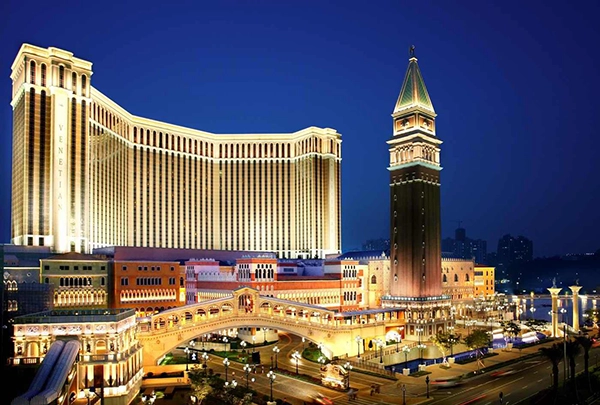
The Venetian Macao in 2026: Casino, Premium Gaming Areas and Macao’s New Role as an Entertainment Destination
The Venetian Macao remains one of the defining properties of Cotai in 2026, but its significance now extends well beyond the size of its casino. Open since 2007, the resort combines a major gaming floor with thousands of suites, premium accommodation, extensive shopping and dining, convention facilities and one of Macao’s principal arenas. That mix has become increasingly relevant as Macao works to strengthen tourism based on entertainment, sport, business events, retail and culture alongside its established casino industry. Current visitor and spending figures show why the change matters: arrivals continue to rise, while non-gaming expenditure is becoming a larger part of the visitor economy. The Venetian Macao sits directly within that transition. Its casino is still a central commercial element, yet investment in premium suites, events and other visitor facilities in 2026 illustrates a broader model in which gaming is one reason to visit rather than the only activity capable of supporting a large Cotai resort.
The Venetian Macao Casino in 2026: Scale, Games and Player Mix
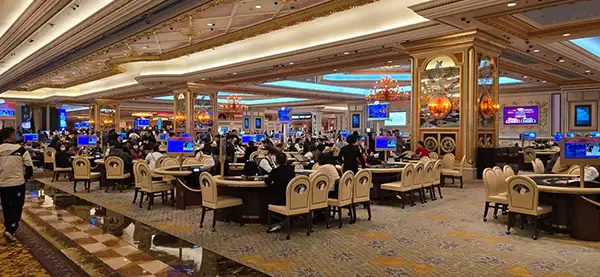
The Venetian Macao continues to operate one of the largest gaming facilities in the city. Sands China reported approximately 503,000 square feet of gaming space and supporting areas at the end of 2025, with around 659 gaming tables and 1,137 slot machines and similar electronic gaming devices. These figures provide a more useful picture of the casino in 2026 than older descriptions that still circulate online, because gaming capacity across Macao has changed under the current concession system. The property combines a large mass-market gaming floor with separate areas intended for VIP and premium customers. Rather than functioning as an isolated casino building, the gaming area forms part of a much larger resort in which hotel accommodation, retail, restaurants, entertainment and conventions can all generate additional visitor traffic.
Table games remain especially important in Macao, and baccarat continues to occupy a central position in the local market. Sands China also identifies blackjack, sic bo, craps and roulette among the conventional table games used in its operations. Electronic gaming and slot machines provide a different style of play for visitors who prefer shorter sessions or lower individual stakes. The balance between these categories is important because modern Macao is no longer built exclusively around traditional high-value VIP play. According to Sands China’s 2025 annual reporting, the mass gaming and slot segments together accounted for 73% of Macao market gaming revenue that year. That figure reflects the long-term rise of mass and premium-mass customers and helps explain why large Cotai casinos now need to serve several types of visitor rather than concentrate almost entirely on a narrow high-roller audience.
Results from the first half of 2026 also show that casino activity cannot be judged simply by looking at headline revenue. At The Venetian Macao, non-rolling chip drop increased by 9.3% year on year, rolling chip volume rose by 15.3%, and slot handle increased by 5.9%. Despite those higher volumes, net casino revenue was US$1.013 billion, 0.6% below the same period of 2025, largely because casino results are affected by changing win percentages as well as the amount wagered. This is useful context for understanding a major resort casino: stronger customer activity does not automatically produce an identical increase in reported revenue over a six-month period. The figures nevertheless indicate that The Venetian remained active across mass-market, premium and electronic gaming segments during 2026.
Premium Gaming Areas and the Changing High-Value Casino Customer
Premium gaming at The Venetian Macao should not be treated as another name for the old junket-led VIP business that once dominated discussion of Macao casinos. Sands China defines premium players as customers who have a direct relationship with the casino operator and generally participate without using gaming promoters. VIP rooms and designated gaming areas can serve both VIP and premium players, allowing the resort to provide a more private environment and higher service levels while maintaining a direct relationship with the customer. This distinction has become more important under Macao’s current regulatory and concession environment. High-value gaming remains commercially significant, but the structure around it is different from the model associated with the city during the peak years of large junket operations.
The premium proposition also extends into accommodation and hospitality. At the end of 2025, The Venetian Macao comprised 2,841 standard hotel suites plus 64 Paiza suites, giving a total of 2,905 suites. The Paiza category is positioned towards higher-value customers, while the resort as a whole uses its all-suite format to distinguish the hotel from conventional room-led properties. In its August 2026 interim report, Sands China confirmed that room renovation and a further premium-suite expansion were under way at The Venetian Macao. This is particularly relevant because the property is almost two decades old. Rather than relying only on its original scale and Venetian design, the operator is continuing to update the accommodation product as newer luxury resorts compete for the same affluent leisure and gaming customers.
Service standards and responsible gambling controls are another part of the premium environment that receives less attention than private rooms or suite design. The gaming areas at The Venetian Macao again passed the Macao government’s Responsible Gambling Indicators programme in 2025 and were recognised as a Responsible Gaming Implementation Model Unit. This matters because premium service does not remove the regulatory duties applied to casino operations. The current model combines customer segmentation, private or designated gaming areas, direct relationships with higher-value players and formal responsible-gaming procedures. In practical terms, The Venetian’s premium strategy in 2026 is therefore broader than simply increasing betting limits: accommodation, personalised service, refreshed facilities and regulatory compliance all form part of how the resort competes for valuable customers.
Beyond the Casino: Suites, Shopping, MICE and The Venetian Arena
The hotel remains a major part of The Venetian Macao’s ability to keep visitors within the resort for longer periods. Its 39-floor tower contains 2,905 suites based on Sands China’s year-end 2025 reporting, and demand remained high in the first six months of 2026. Hotel occupancy reached 98.6% during that period, with an average daily rate of US$200. These numbers are especially notable when compared with Macao as a whole, where average hotel-room occupancy was 90.4% in the first half of 2026 and five-star establishments averaged 93.8%. The Venetian therefore entered its current renovation cycle from a position of very high room utilisation. Updating suites while maintaining that level of demand is part of the effort to keep an established Cotai property competitive against more recently completed accommodation elsewhere in the city.
Retail and dining provide another substantial non-gaming layer. At the end of 2025, Sands China reported approximately 960,000 square feet of retail space at The Venetian Macao, with 359 shops and 66 restaurants and food outlets. The shopping area uses canals, indoor streets and architectural references to Venice to create a setting that can attract visitors who never enter the casino. During the first half of 2026, Shoppes at Venetian generated US$128 million in mall revenue, while tenant sales per square foot rose by 27.1% year on year. The figures show that retail is not merely decorative space surrounding the casino. It represents a sizeable commercial activity of its own and benefits from the same visitor flows generated by hotel stays, conventions, concerts, sports events and general Cotai tourism.
The resort is equally significant for business tourism. The Venetian Macao contains approximately 1.2 million square feet of convention and meeting space, giving it a role that extends well beyond leisure travel. Large exhibitions, corporate meetings and incentive groups can use accommodation, restaurants, retail and entertainment without leaving the wider Cotai complex. That relationship between MICE and other visitor spending is increasingly valuable to Macao. In 2025, the city hosted 1,861 MICE events, 22.1% more than in the previous year, while the number of participants and attendees reached approximately 1.47 million. Receipts generated for non-gaming industries by MICE activity rose to MOP6.28 billion. The scale of The Venetian’s convention facilities means the property is directly involved in a segment that Macao authorities continue to identify as an important part of economic diversification.
The Venetian Arena and the Growth of Event-Led Tourism
The Venetian Arena has become one of the clearest examples of how an established casino resort can create reasons to visit that have nothing to do with gambling. The venue underwent a major upgrade and reopened in late 2024 with capacity for approximately 14,000 spectators. The work included new VIP suites and improvements to lighting, acoustics and other venue facilities. That investment increased the arena’s suitability for major concerts and international sporting events at a time when Macao has been placing greater emphasis on event-led tourism. A large arena attached to thousands of hotel suites, extensive retail, restaurants and convention space also creates commercial links between an individual event and spending across the rest of the resort.
Basketball has become particularly visible within this strategy. The renovated arena hosted the NBA China Games in October 2025, bringing the Brooklyn Nets and Phoenix Suns to Macao. The event was accompanied by community and fan activities across Sands China properties. The NBA China Games are scheduled to return to The Venetian Arena on 9 and 11 October 2026, this time with preseason games between the Dallas Mavericks and Houston Rockets. A separate NBA Fan Day is scheduled for 10 October. These events demonstrate how The Venetian can attract visitors around a specific date and programme rather than depending solely on continuous casino traffic. International sport also gives Macao material that can be promoted to audiences who may previously have associated Cotai primarily with gaming.
Event activity is not limited to arena ticket holders. Cotai Expo at The Venetian hosted the 2026 Sands Shopping Carnival from 23 to 26 July, attracting nearly 160,000 visits over four days. The event included more than 580 booths as well as food, cultural and creative businesses, family activities and sports experiences. This type of programme illustrates the wider use of the property’s enormous indoor areas: convention halls can serve exhibitions, retail events, local businesses and public activities in addition to traditional corporate meetings. Combined with concerts, sport, theatre and permanent attractions, this gives The Venetian a more varied annual calendar and reduces the idea that every visit to a Cotai resort must be centred on casino play.
Macao in 2026: From Casino City to a Broader Entertainment Destination
Macao’s visitor statistics in 2026 show strong demand, but they also reveal the challenge facing the city’s tourism strategy. During the first seven months of the year, Macao recorded 24,486,664 visitor arrivals, an increase of 8.0% compared with the same period of 2025. International arrivals reached almost 1.60 million and increased by 5.1%. However, overnight visitor numbers edged down by 0.3%, while the overall average length of stay fell to 1.0 day. The difference between rising arrivals and relatively flat overnight traffic explains why entertainment, dining, retail and events have become so important. The economic objective is not simply to increase the number of people crossing the border, but to provide enough reasons for visitors to stay longer and spend across a wider range of businesses.
Non-gaming spending suggests that the broader tourism economy is gaining momentum. In the first half of 2026, visitor expenditure excluding gaming reached MOP44.47 billion, 17.4% higher than a year earlier. Average non-gaming spending per visitor increased by 7.8% to MOP2,123. Shopping represented 46.0% of the total, followed by accommodation at 22.3% and food and beverages at 21.5%. Visitors travelling primarily for MICE events spent an average of MOP4,593 each, considerably above the overall visitor figure. These numbers help explain why a resort such as The Venetian Macao has strategic value beyond its casino floor. Its shops, restaurants, suites, convention halls and entertainment venues are closely aligned with the categories in which authorities and operators want more visitor spending to occur.
The policy direction is also explicit. Macao’s 2026 Policy Address calls for deeper integration between tourism and gastronomy, events, conventions, education and health-related activities, while also seeking more visitors from international markets. Gaming concessionaires are expected to fulfil substantial non-gaming investment commitments under concessions that began in 2023. Venetian Macau Limited has committed at least MOP35.84 billion in investment through December 2032, of which MOP33.39 billion is designated for non-gaming projects. The programme includes conventions and exhibitions, entertainment, sporting events, culture and art, international tourism, themed attractions and gastronomy. The scale of that commitment makes diversification a contractual part of the current casino era rather than a secondary marketing exercise.
What The Venetian Macao Represents in Macao’s New Tourism Model
The result is not the disappearance of casino gaming from Macao’s economy. The Venetian itself generated just over US$1 billion in net casino revenue during the first half of 2026, showing that gaming remains a fundamental part of the property. The change is in the number of additional reasons a visitor may have for entering and staying at the resort. A business traveller can attend a convention, a sports fan can visit for an NBA game, a leisure visitor can stay in a suite and use the shopping and dining areas, and a casino customer can combine gaming with those same facilities. This wider mix allows the property to serve multiple customer groups at the same time rather than treating every visitor primarily as a gambler.
The Venetian also benefits from its position within the interconnected Sands Resorts Macao area on Cotai. The Venetian, The Parisian, The Londoner and The Plaza sit within a large cluster of hotels, shops, restaurants, meeting facilities and entertainment venues, making it possible for visitors to move between different themes and price levels without travelling to another part of the city. In this context, The Venetian’s age can be an advantage as well as a challenge. It is already widely recognised and has extensive existing infrastructure, but it must continue to refresh rooms, premium services and visitor facilities as newer resorts raise expectations. The ongoing 2026 suite renovation programme shows that the property is being updated rather than preserved in its original 2007 form.
The remainder of 2026 will continue to test how successfully this model works. The premium-suite expansion is still part of Sands China’s current investment activity, while October’s NBA programme will again place The Venetian Arena at the centre of a major international sporting event. At city level, Macao is also reviewing concessionaires’ performance during the 2023–2025 period, including gaming and non-gaming investment commitments. For The Venetian Macao, the direction is therefore clear even though casino gaming remains commercially important: the property is increasingly expected to function simultaneously as a casino, luxury hotel, retail centre, MICE venue and major entertainment location. That combination reflects Macao’s broader 2026 objective of building a visitor economy in which gaming remains significant but no longer has to carry the entire tourism proposition.